
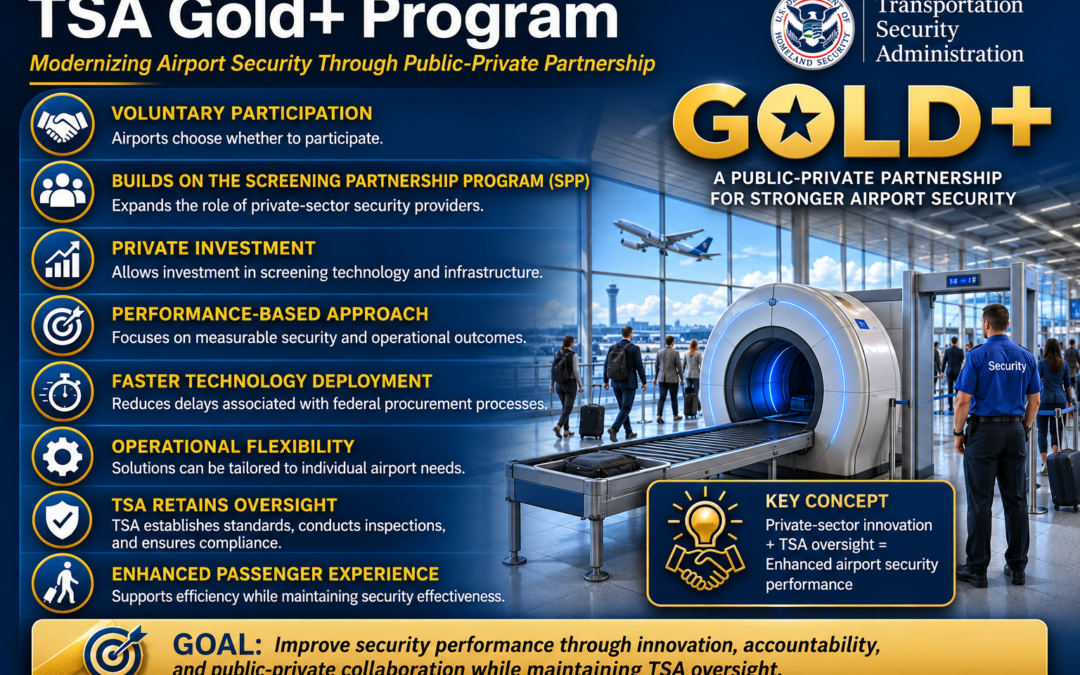
The Transportation Security Administration is moving forward with its new “TSA Gold+” program, an operational shift that has reignited the debate over federal vs. private airport security screening.
Gold+ is not a passenger-facing subscription or a new expedited screening lane like TSA PreCheck. It is an internal administrative model. Building on the foundation of the decades-old Screening Partnership Program (SPP)—which already uses private screeners under federal oversight at 20 U.S. airports, including San Francisco and Kansas City—Gold+ significantly expands the private contractor model.
Under the traditional SPP, the federal government keeps ownership and procurement responsibilities for all screening technology, while the private contractor staffs and manages screening personnel. Gold+ changes that equation. If an airport voluntarily opts into the program, the private vendor takes on an integrated role: managing the front-line workforce and assuming some level of responsibility for technology procurement, equipment maintenance, and lifecycle hardware upgrades.
Potential Features of Gold+
The driving force behind this initiative is speed and agility. The standard federal procurement cycle for screening technology can move at a glacial pace; upgrading legacy carry-on baggage systems to modern CT scanners under standard budgeting can take over a decade. By using private-sector investment models, private industry may be able to bypass the bureaucratic hurdles to field advanced tech and to more quickly adapt checkpoint designs. Additionally, a privately managed workforce may better insulate an airport’s daily operations from the severe staffing disruptions that occur during federal government shutdowns.
What the Consumer Journey Could Look Like Under Gold+
For the average traveler, the introduction of TSA Gold+ may not feel much different. The passenger experience at the checkpoint should follow the same procedural flow passengers are used to today.
- Arrival & Identification: Passenger will walk up to the podium and present their ID or utilize biometrics just the way it is done now. The screening personnel may wear a different uniform badge representing the private contractor rather than the TSA emblem, but their authority and standard operating procedures are identical.
- Prohibited Items & Rules: The rules regarding liquids and electronics, do not change. A private contractor cannot alter the federal prohibited items list or loosen screening criteria.
- The Invisible Difference: Where consumers may notice a difference is in the surrounding infrastructure. Because procurement is detached from federal budget delays, a Gold+ checkpoint may feature newer scanners, and highly automated screening lanes. Optimized physical layouts might be used to reduce wait times and remove or reduce checkpoint bottlenecks.
The Governance Paradox
While the promises of accelerated technology deployment and operational flexibility are highly appealing, the program does introduce governance questions.
Under Gold+, the TSA modifies its role from day-to-day operational manager to a regulatory inspector, setting security standards and conducting compliance audits. Oddly, TSA does the same thing now, but in the existing model, TSA is both the screener and the regulator. However, when private entities own both the workforce and the hardware, it may complicate the clear lines of federal oversight. Some critics have pointed out the inherent tension of inserting profit motives into national security decisions, alongside the risk of creating a two-tiered aviation ecosystem where well-funded hubs rapidly deploy superior tech while smaller regional facilities may lag behind.
This pivot toward privatization is a change in the post 9/11 world where after the terrorist attacks the government was adamant that transportation security is a government function and the elimination of government screeners was the untouched third-rail. Although I’ve argued against getting rid of TSA as a federal agency, I must distinguish that I’ve not argued to retain TSA screeners. I’ve said that before a wholesale deployment is made, we need to assess how such a move will affect the system on a nationwide level. What works at 20 airports under the SPP, may or may not work under hundreds of airports under Gold+. That said, Gold+ might just be that type of system.
Counter-arguments to the private sector model is whether TSA can rapidly share intelligence information with contractors and roll out new procedures with the same speed and efficiency they might be able to now. Also, some critics have pointed out that under the SPP if a contractor isn’t fulfilling its duties, TSA can redeploy their own personnel into that airport, while another contractor is selected, or even permanently. Under a total contractor model, the TSA’s screening workforce will be dismantled and replaced, thus eliminating that leverage.
For airport executives, Gold+ is far more than a staffing change. It is a fundamental shift in how we approach capital investment, vendor relationships, and regulatory governance. Over the next decade, the success of this model will be judged both by how fast a passenger moves through a lane, and by how rigorously we maintain standardized federal security thresholds across a decentralized network.
Frequently Asked Questions
Is TSA Gold+ a privatization of the TSA?
Not entirely, but it is a significant step toward a public-private partnership model. The TSA remains the sole regulatory authority. It establishes the security rules, mandates the training standards, and conducts regular compliance audits. The private contractor executes those rules and manages the daily logistics, staffing, and equipment procurement under strict federal oversight.
Does Gold+ replace TSA PreCheck or CLEAR?
No. TSA PreCheck and CLEAR are passenger-facing programs aimed at expedited identity verification and screening. Gold+ is strictly a administrative and operational framework determining who manages the checkpoint staff and hardware. PreCheck status works exactly at a Gold+ airport.
Will private screening lead to lower security standards?
Private contractors operating under the TSA Gold+ framework must utilize the exact same standard operating procedures and pass the same rigorous testing as federal TSA screeners. However, the long-term industry debate centers on whether profit-driven corporate structures will manage workforce retention and hardware maintenance as effectively as a centralized federal agency.
Why would an airport voluntarily choose to opt into Gold+?
The primary incentive is capital and speed. Federal procurement cycles for multi-million dollar imaging and screening technology can take years to clear budgetary hurdles. Under Gold+, private investment structures might allow airports to deploy cutting-edge technology and optimize lane designs quickly, and insulated from federal budget constraints or government shutdowns.