
Late Friday night, May 9th, a man accessed the airfield at Denver International Airport and was struck and killed by a Frontier Airlines plane during takeoff. According to Department of Transportation Secretary Sean Duffy, the person scaled the perimeter fence and ran onto a runway.
Intrusions such as this are uncommon but not unheard of at airports. Although TSA does not release official statistics, a routine check of Google shows numerous incidents involving fence jumping and perimeter intrusions. Based on what we know right now, here are some answers to questions you may have about airfield security.
How was someone able to access an active runway at one of the busiest airports in the world?
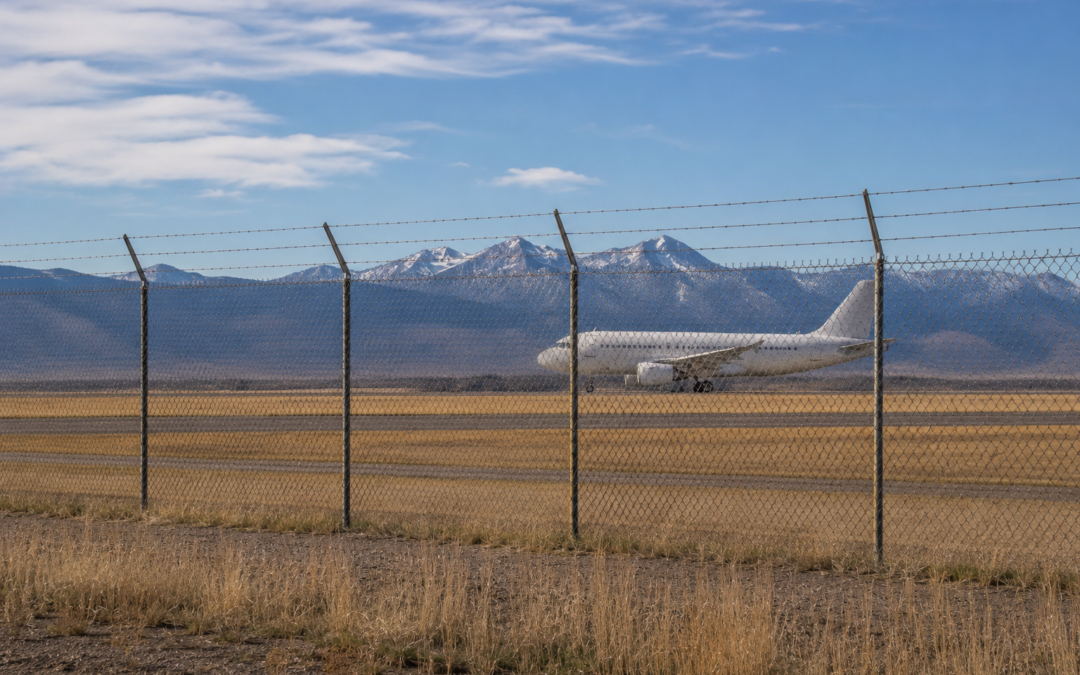
At a minimum, the height of airport perimeter fencing can average 6-8 feet tall – each airport is different, so it depends on what TSA has approved for that airport’s security program. The fence has to be chain link, with barbed wire on top. Climbing such a fence is not that difficult. The fence is really designed as a deterrent and delaying measure to keep people from accessing aircraft (fencing standards are in FAA Advisory Circular 150/5370-10H, however a specific height is not recommended in the AC – it’s just the closest thing to any official regulatory or guidance information there is – otherwise it’s airport specific).
Although some airports exceed this standard, many simply meet the minimum requirement. With miles of perimeter fencing, installing higher levels of fencing is extraordinarily expensive compared to how infrequently incidents like this occur.
Why didn’t air traffic control or airport operations see the person sooner?
The incident occurred late at night, making detection very difficult. Additionally, the size of Denver International makes detection even more difficult because of the distances between the tower and certain areas of the perimeter. Roving security patrols do not always spot someone either, as they cannot be everywhere at all times.
Were surveillance systems functioning properly?
I can’t speak to the specific security measures in place at a particular airport or whether they were functioning properly. There are CCTV cameras and other security measures in place at many commercial service airports, so the airport will likely review whether the intrusion was captured on camera or detected through other available technology.
TSA does not require Perimeter Intrusion Detection Systems (PIDS) at airports. The fence itself is the minimum requirement. These systems send an alarm to the airport operations center if an individual attempts to jump or cut the fencing, allowing responders to investigate the situation.
Even if a system like this was in place at DIA, it still may not provide enough time for responders to arrive before an intruder reaches the runway or ramp areas.
Who bears responsibility for this incident?
Airport operators are responsible for providing airfield and perimeter security. TSA’s role is primarily regulatory compliance. TSA screeners do not have responsibility for perimeter security.
Were existing TSA security requirements followed?
That will likely be part of the subsequent investigation. The FAA will also likely conduct an investigation because this is considered a runway incursion, and there have recently been numerous runway incursion incidents at U.S. airports.
Why aren’t higher perimeter security measures required by the government?
Primarily because of the cost of implementing higher levels of security compared to how infrequently incidents like this occur. Although perimeter breaches do happen, the vast majority involve individuals who are intoxicated or in an altered or unstable mental state. Most incidents do not result in intentional damage to aircraft. In short, it simply does not happen often enough to justify the expense, at least not yet.
Will airport perimeter security be reviewed?
Most likely, because this incident is more severe than the typical fence-jumping event due to the fatality and aircraft damage. However, perimeter security has been reviewed numerous times following previous incidents without resulting in major regulatory changes.
What do you personally think about airport perimeter security requirements?
I’m a fan of Perimeter Intrusion Detection Systems. They provide higher levels of security and safety for airport operations. Although responders still may not be able to arrive in time after a PIDS alert, there is at least a higher chance of detecting a breach sooner rather than later.
However, like any technology, PIDS are not 100% effective. Ultimately, it comes down to cost-benefit analysis.
Are there concerns about copycat incidents?
Always. This seems to occur a lot in our industry and frankly any time there is an incident, aviation related or otherwise. People are apparently drawn to the attention and notoriety they receive.
What do you say to passengers frightened by this incident?
This is a highly unusual situation, and the likelihood of it occurring frequently enough to justify public concern is extremely low. Additionally, after an incident like this, airports tend to operate in a heightened state of vigilance, at least temporarily, to watch for similar situations.
Would you personally feel safe flying out of DEN today?
Yep, do it all the time.
Is this negligence?
That will be part of the investigation. Sometimes you can do everything right and someone still finds or exploits a gap in the system. There will always be gaps in security systems. Some gaps must exist simply for the system to function operationally.
Risk analysis is a major part of airport operations. Airports constantly make decisions about where to allocate limited funding for safety and security because not all risks are equal, and there is never enough money to do everything you would ideally want to do.
Hot Takes:
How unusual is a runway pedestrian strike involving a commercial aircraft?
Very unusual. Almost never happens.
What layers of airport security are supposed to prevent this?
Primarily airport fencing, airfield patrols, and sometimes perimeter intrusion detection systems.
Why are runway incursions such a serious hazard?
They can result in damage to aircraft and airport infrastructure, as well as fatalities and injuries.
Could pilots realistically avoid someone on a runway during takeoff?
Likely not without creating even greater danger for passengers. The aircraft was reportedly traveling at over 140 miles per hour, and evasive action could have placed the aircraft in an even more dangerous situation. Pilots may attempt an early take off, but aircraft must still achieve minimum takeoff speed before becoming airborne.
How difficult is it to monitor an airport the size of DEN?
Very difficult. From a land-area perspective, DEN is the largest airport in the United States and one of the largest in the world. That is a tremendous amount of ground to monitor.
___
Content generated by Jeffrey C. Price; AI used for editing only
Approved for use and quotes by the media
Price is the lead Author of the textbook Practical Aviation Security: Predicting and Preventing Future threats, the former Assistant security Director of Denver International Airport and a professor at the Metropolitan State University of Denver.
**Image is AI Generated




Hello Jeffrey,
I’m reaching out on behalf of ABC News and we are doing the Frontier Airlines incident in Denver tonight.
We were hoping you would be available for a zoom intv – based on some of your interview from here:
Man dead after accessing a runway at Denver International Airport (DIA) and being struck by plane – Leading Edge Strategies
Please let me know if you are able to do it.
Thank you for your time and consideration,
Roger Lee
Producer
ABC News
917-743-2349
roger.k.lee@abc.com